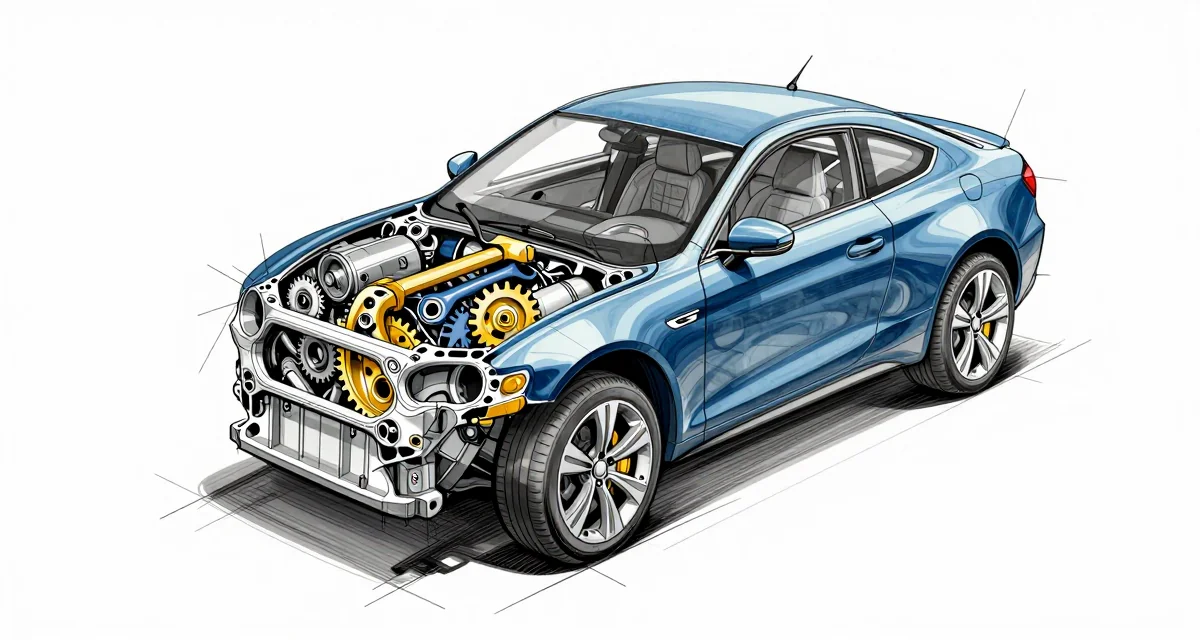
Why Automotive Is a Separate Translation Specialty
The automotive industry generates enormous volumes of documentation: a single new vehicle means 3,000–5,000 pages of owner's manual, up to 50,000 items in the spare parts catalogue, and hundreds of technical service bulletins annually. Every document must be translated accurately, within tight deadlines, and using terminology consistent with previous models.
Key differences between automotive and general technical translation:
- Strict OEM brand glossaries: Toyota, BMW, Hyundai, KAMAZ — each manufacturer has its own terminology standard that cannot be deviated from
- Regulatory documentation overlaps between countries: UNECE (Geneva Regulations), EU (ECE), Russia (TR CU 018/2011), China (GB), Japan (FMVSS)
- Multilingualism: a single project often requires 5–10 languages simultaneously
- Repetitiveness: up to 60–70% of text overlaps from model to model, making written translation with Translation Memory cost-effective
Since 2013, we have translated over 40,000 pages of automotive documentation for Russian and international manufacturers, dealer networks, and automotive component suppliers.
Types of Automotive Documentation
Automotive documentation falls into several categories, each with its own translation specifics:
Owner's Manuals:
- Volume: 300–600 pages per model
- Format: FrameMaker, InDesign, XML (DITA)
- Specifics: text is linked to illustrations — callouts, captions, warnings. Translation must not change figure numbering or text references
- Regulatory requirements: in the EU, manual content is regulated by Directive 2007/46/EC
Spare Parts Catalogues:
- Tens of thousands of items with part numbers, names, descriptions
- Format: database (EPC) or PDF/Excel
- Key requirement: terminology consistency — "brake pad" cannot become "friction lining" in the same catalogue
- Loading into TM enables automatic substitution when the catalogue is updated with a new model
Technical Service Bulletins (TSB):
- Operational documents: translation deadline — 1–3 days
- Volume: 2–15 pages each, but dozens per month
- Contain step-by-step instructions with illustrations: translation of each step must be unambiguous
PPAP Documentation (Production Part Approval Process):
- A set of 18 elements per AIAG: drawings, FMEA, Control Plan, MSA, SPC data
- Required when supplying automotive components to an OEM assembly line
- Translation is needed when a Russian supplier undergoes an audit or submits documentation to a foreign customer
UNECE Regulations and Type Approval
UNECE (United Nations Economic Commission for Europe) develops technical regulations effective in 58 countries participating in the 1958 Geneva Agreement. Russia has been a participant since 1987.
Main categories of UNECE regulations we translate:
- ECE R 13 — vehicle braking systems
- ECE R 43 — safety glazing
- ECE R 100 — electric vehicles (high-voltage systems)
- ECE R 154 — RESS (battery system) safety
UNECE regulation translation is a legally significant process. Official UN languages are English, French, and Russian. However, when applying for type approval in a specific country, translation of test reports and additional documentation into the national language is often required.
Russian type approval (vehicle type approval, OTTS) is regulated by TR CU 018/2011. When importing vehicles or components, we translate:
- Test Reports from foreign laboratories
- Certificates of Conformity (CoC)
- Technical Specifications
- Type Approval Communications
Regulatory documentation translation is performed with notarization when required.
GOST R for Automotive Components and DIN/ISO
Russian standards for automotive components (GOST R 41 series) are essentially adaptations of UNECE regulations. However, there are purely Russian standards as well:
- GOST 33670-2015 — general vehicle safety requirements
- GOST R 51709-2001 — technical condition requirements
- GOST 33997-2016 — pollutant emissions
When translating from German, DIN standards are frequently encountered, many of which became the basis for ISO:
- DIN 72552 / ISO 15170 — electrical contact coding (terminal 30, terminal 15, terminal 87 — designations with no intuitive translation)
- DIN EN ISO 6520 — classification of weld joint defects
- ISO/TS 16949 → IATF 16949 — quality management system in automotive
An automotive translator must know which DIN standards have been superseded by ISO and which remain independent. We maintain a cross-reference database of German, European, and Russian standards.
Terminology Management for OEM Brands
Each automaker maintains its own terminology glossary. BMW, Mercedes-Benz, Volkswagen, Toyota, Hyundai — all have different terminology, sometimes for the same parts.
How we work with terminology:
- We receive the OEM glossary (if available) or develop one based on previous brand documentation
- Load it into SDL MultiTerm or memoQ termbases
- The CAT system auto-inserts terms and flags deviations
- New terms (for new models or technologies) are approved with the client before mass translation begins
The result — terminology consistency across the manual, catalogue, and service bulletins for a single brand. This is critical for dealer networks, where a mechanic searches for a part by name.
Language Pairs and Volumes
Key language directions in automotive:
- German ↔ Russian. BMW, Mercedes-Benz, Volkswagen, Audi, Porsche. German is the language of engineering documentation (Lastenheft, Pflichtenheft, Stückliste). Our German translators have automotive specialization and 7+ years of experience.
- Japanese ↔ Russian. Toyota, Honda, Nissan, Mitsubishi, Subaru. Japanese documentation often contains mixed text (kanji + Latin + numbers), requiring technical literacy in both languages.
- Korean ↔ Russian. Hyundai, Kia, SsangYong. The Korean automotive industry is actively developing in Russia: assembly in St. Petersburg (Hyundai), dealer networks nationwide.
- Chinese ↔ Russian. Chery, Haval, Geely, BYD, Changan. Since 2022, Chinese-Russian automotive translation volumes have quadrupled. Specifics: Chinese technical documentation is often less structured than German or Japanese.
- English ↔ Russian. Ford, GM, JLR, plus all international type approval documentation.
Project volumes in automotive:
- New model owner's manual — 300–600 pages, 3–6 weeks
- Complete spare parts catalogue — 2,000–5,000 pages, 2–4 months
- Monthly service bulletin package — 50–200 pages, 5–10 business days
- PPAP package — 100–300 pages, 2–3 weeks
Pricing and Working Conditions
Pricing for automotive documentation translation depends on language pair, format, and volume:
- Technical translation (EN/DE → RU) — from 850 RUB per page (1,800 characters of translated text)
- Translation from Japanese/Korean/Chinese — from 1,600 RUB per page
- Spare parts catalogues (tabular format) — from 400 RUB per page
- DTP/layout — from 500 RUB per page (InDesign, FrameMaker)
- 10% discount for volumes over 500 pages
Productivity: 8–12 text pages per day, catalogues — up to 20 pages per day (including TM repetitions).
We work under contract and sign NDAs — confidentiality is critical for automotive (pre-production documentation, patent applications). Simplified taxation (no VAT). Office in Moscow, working remotely with clients across Russia. We accept documents via EDI (Diadoc, SBIS) and provide a full set of closing documents. Ready to discuss your project — contact us.
 Max
Max